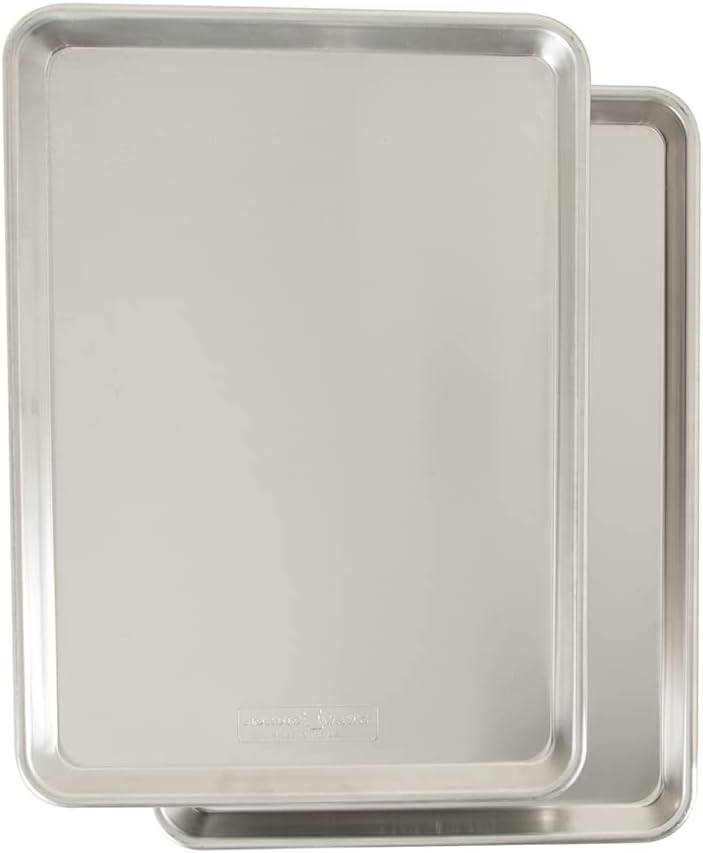
What Is the Nordic Ware Half Sheet Pan?
The Nordic Ware Naturals Baker’s Half Sheet is a natural aluminum baking sheet made by a family-owned company in Minneapolis, Minnesota — a brand that has been producing bakeware since 1946. The half sheet size (18″ x 13″) is the standard used in professional and restaurant kitchens worldwide, and this is the consumer version of that same commercial-grade pan.
There is no nonstick coating. No PTFE. No PFOA. No ceramic layer. Just natural aluminum with an encapsulated galvanized steel rim that prevents warping. That uncoated surface is not an oversight — it is the point. Natural aluminum conducts heat more evenly than coated alternatives, browns food uniformly edge to edge, and at 1.65 pounds per pan, it is light enough to handle one-handed with oven mitts.
After analyzing data across 34,000 verified Amazon buyer reviews and cross-referencing buyer feedback across Reddit home cooking communities and owner forums, Deborah found this to be the most consistently praised baking sheet in its price range over a sustained period — with a very specific set of complaints that repeat in a clear pattern. This review covers both sides honestly.
What 34,000 Buyers Consistently Praise
The praise across tens of thousands of verified reviews falls into five consistent themes. These are not scattered compliments — they appear repeatedly across buyers who purchased years apart, which signals genuine long-term performance rather than honeymoon enthusiasm.
Zero warping, verified across years of use. The most repeated praise in the entire review base. Buyers who have owned these pans for five, eight, and ten-plus years report the same thing: the pans have never warped, bowed, or buckled at high heat. One verified buyer with eight years of daily use noted they purchased a second set to pass one down to their daughter — the originals still performing identically. This stands in direct contrast to cheaper baking sheets, which warp loudly in the oven within months of purchase.
Even browning edge to edge. Across cookies, roasted vegetables, bacon, sheet pan dinners, and frozen foods, buyers consistently report that food browns uniformly — no burned edges while the center stays pale, no hot spots, no uneven coloring. This is the core benefit of natural aluminum: superior heat conductivity compared to stainless steel and dark-coated pans, combined with the light color that prevents the over-browning that dark pans cause.
Lightweight without feeling cheap. At 1.65 pounds, the pan is easy to maneuver in and out of a hot oven. Buyers who bake in large batches — cookies, holiday baking, meal prep — specifically call this out as a deciding factor. Heavier pans like the Hestan (4.6 lbs) and Caraway (3.7 lbs) get flagged for fatigue during extended baking sessions.
Lasts years, often decades. Multiple verified buyers report owning these pans for ten or more years with no degradation in performance. This is a recurring theme that separates Nordic Ware from nonstick alternatives — ceramic and PTFE coatings have a finite lifespan of one to three years under normal use, while natural aluminum has no coating to degrade. What you buy on day one is what you have on year ten.
Genuine value at the price point. Two pans for $32–$33 at a price that buyers consistently describe as punching well above its weight. Verified purchasers regularly compare it favorably against pans costing two to four times as much, including premium brands that underperform on warping or evenness.
The Four Things That Will Surprise You
The complaints in this review base are not random. They cluster into four specific patterns that repeat across thousands of buyers — and every single one of them is avoidable once you understand how natural aluminum actually works.
The dishwasher will permanently darken it
This is the single most consistent complaint in the entire review base. Buyers who put the pan through even one dishwasher cycle report it coming out dark gray to black — a dramatic cosmetic change that cannot be fully reversed. Nordic Ware’s own documentation is explicit: dishwasher detergent reacts chemically with natural aluminum and causes discoloration. Crucially, this is cosmetic only. The pan’s baking performance is unaffected. But buyers who were not warned feel blindsided. The fix is simple and permanent: hand wash with warm soapy water and a non-abrasive sponge. Dry it completely after washing to prevent water spots in the rolled rim. That is all the maintenance this pan requires.
There is no nonstick coating — and sticky foods will stick
Buyers expecting a slick surface are the second-largest complaint segment. Natural aluminum is not nonstick in the way a coated pan is nonstick. Caramelized sugars, cinnamon roll dough, roasted tomatoes, and any food with high sugar or fat content will bond to the bare surface without a barrier. The solution that virtually every experienced buyer recommends: use parchment paper or a silicone baking mat for any sticky or sugary recipe. With parchment, nothing sticks. Without it, certain foods will. This is not a defect — it is how uncoated aluminum is designed to be used, and the baking community has used it this way for decades.
Acidic foods will pit and darken the surface over time
Aluminum is chemically reactive with acidic ingredients. Vinegar-based marinades, lemon juice, tomatoes, and other acidic foods will react with the pan surface after prolonged contact — darkening, pitting, or staining it permanently. Again, this does not affect baking performance or food safety. But buyers who regularly roast tomatoes or cook acidic sheet pan meals directly on the surface are caught off guard. The fix: use parchment paper or aluminum foil as a barrier for acidic recipes. This takes ten seconds and eliminates the issue entirely.
The rolled rim can trap water
A smaller but consistent complaint: the back edge of the pan, where the aluminum is rolled rather than fully sealed, can hold water if the pan is not dried properly after washing. Over time this can lead to surface spots. The fix: after washing, pat or towel-dry the pan completely — including tilting it to drain any trapped water from the rim — before storing.